


Something was buzzing in the in-between at the last Cœureographers Open Field Studio. Excitement. Mutual inspiration. Collective care. Perhaps something closer to a bee waggle dance than an audience development webinar: the embodied practice of what it means to organise ourselves like nature.
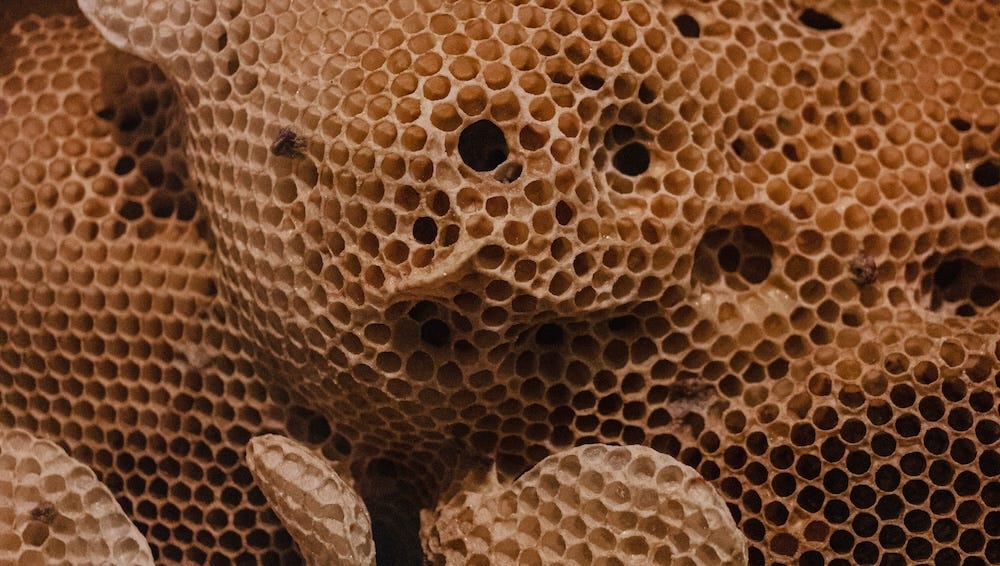
At the heart of what emerged was The Hive. It asked us about our capacity to shapeshift into being an artisan bee, to belong to a guild within a honeycomb structure, and by doing that, to contribute to thriving landscapes.
“Instead of being a mass or coming into one big circle, we can actually honeycomb it. Maybe that’s the shape we need to look at more.”
What the space held
We moved through three bodies in that session. The personal body. The movement body. The place body. Three of the moves of an ecosystem choreography, each opening a different question.
The personal body asked: which archetype are you currently carrying, in this field, at this phase? Which one is present, hinting at your contribution to the ecosystem(s) you are part of?
One person observed that they find themselves in the Pioneer, the Weaver, and the Elder simultaneously, in different ways, and that these archetypes are also in relationship among themselves. Not a single presence but a mosaic. Like essences in a perfume doing the enchantment together, each note necessary to the composition.
For another, in the movement, what surfaced was the image of tidal movement. The back and forth of contrasting forces composing a wave that lands on shore, stretches, and slowly retreats. A coming back into lunar rhythm. Fluid between polarities pulling and releasing. And with it, at times an overwhelm, an intuitive uncertainty, until the moment of sudden clarity: “I know exactly what I’m talking about.”
We danced between sensing the moment as immersive experience, and stepping back to observe the pattern from a wider perspective. A rhythm in itself: immersion, emergence, return. What one participant named as a kind of remembrance:
“It feels like a kind of remembrance that means we can choose. Now we’re the swarm, now we’re the hive, now we can dance. When we don’t feel a choice, we feel either completely paralysed or completely swept away with the wind. This feels like an anchoring.”
This choreography landed in cultural soil, a modern soil marked by complexity. The Hive emerging as the structure that can hold the complexity of the changes at hand. And perhaps importantly, re-integrate functions played within professional, economic, and social systems that are currently in disintegration.
Three threads that moved through the room
Looking at what connected the personal, collective, and place bodies across the session, three threads kept reappearing.
Hybridity. We are rarely accompanied by a single archetype. Most of us carry the Pioneer, the Weaver, and the Elder in different proportions, at different phases, in different contexts. There is the longer-term archetype that has been present across years, and the more acute presence arriving right now as a guide. Archetypes are not chosen. They find you, through synchronicities, through what keeps reappearing in the peripheral field.
Thresholding. Someone described moments in her professional life when the group was truly swarming: that extraordinary feeling of collective momentum, emergent movement, direction without direction. Until the initial energy wasn’t held anymore. It imploded. Became something else.
“There were moments at work when we felt we were literally swarming. An amazing feeling. Until the initial energy isn’t held anymore. It implodes and becomes something else.”
The swarm has its own cycles of intensity and rest. It is not a permanent state. There is landing, reconstitution, and the question of what shape comes next. The choreographic intelligence lies not in sustaining the swarm indefinitely, but in developing the sensitivity to know when it is time to let it land.
The quality of movement. Is it slow and steady? In tension or creatively loose? Erratic or collectively synchronized? Where is it in flow and where is it stagnant? Reading the quality of the dynamic as indication on what’s possible here.
The Hive Archetype
The hive is an astonishing example of distributed intelligence producing complex, coordinated production. The queen does not command. She reproduces, holding the generative and energetic core — less a ruler than a living anchor of continuity. The workers do not receive orders. They follow chemical gradients, waggle-dance communications, and local feedback loops. What results from all of this is not simple:
Architecture: honeycomb geometry with near-perfect efficiency, encoding both shared memory and future capacity
Climate regulation: the hive maintains a precise internal temperature regardless of external conditions
Collective decision-making: swarm sites are chosen through democratic quorum through dancing, not executive directive
Surplus: the cultural equivalent of honey, enabling the whole constellation to survive winter
The hive is not a factory. It is a living, breathing, climate-regulating, decision-making organism constituted collectively through shared dance, a specifically shaped place, and different (archetypal) roles played.
The hive embodies a specific role architecture. These roles are biochemically assigned and may shift across an individual worker’s lifecycle. Mapped to human organisations, they look something like this:
Queen: holds reproductive continuity; what an organisation’s founding vision or cultural DNA actually is when it is healthy
Nurse Bees: tend the developing young; mentors, educators, onboarding stewards
Builder: produces the geometry of shared memory; designers, architects, protocol-writers
Forager: ranges widely, brings nourishment and intelligence back, performs the waggle-dance; field researchers, connectors, business development
Guard: holds the threshold, determines what enters and what does not; legal, values stewardship, editorial
Scout: explores beyond the known range; futures practitioners, R&D, horizon-scanners
Climate Regulator: maintains internal conditions; operations, HR, culture stewards
The hive also follows patterns of disintegration. Calcification. When the waggle-dance stops working because the foragers have found nothing new, and the system keeps sending scouts in the same directions out of habit. Or when the hive mistakes its own internal climate for the health of the wider ecology, a disconnected self-image. The organisation maintains perfect internal culture while extracting from the watershed it depends on. Hive-choreography applied to contexts that need swarm or pioneer responses will suffocate them.
The Hive belongs to a mid-succession to climax ecosystem phase. It takes years to reach its full complexity. Its gift, when it arrives at the right stage in the right soil, is the production of surplus that makes cultural winter and economically difficult times survivable.
What this might teach the labour market
The current labour market operates on what I have been calling the atomisation of being: a logic of radical individualism in which every person is a sovereign unit competing for position, negotiating separately, absorbing risk alone. Employers cannot find the workers they need. Workers cannot find work attuned to what they actually carry. Youth unemployment swells while specific sectors face massive unmet demand:
Regenerative agriculture and soil restoration
The care economy and relational work of all kinds
Renewable energy and the built environment transition
Bioregional food systems and local value chains
The macro disruptions already underway in automotive, white-collar administration, and large-scale production will accelerate that mismatch in ways the current architecture has no capacity to absorb.
The guild was a pre-modern answer to exactly this problem. Medieval guilds organised vocational education. They held apprenticeships, transmitted craft knowledge, encoded shared standards, offered solidarity funds for members in difficulty, created belonging through shared symbology and ceremony, and maintained relationships with the places and communities they served. They were often local (or bioregional) by nature rather than by design philosophy, but because the soil they grew from was local, the clients they served were local, the knowledge they encoded was place-specific.
Their shadow is equally real. Guilds could be exclusive, protectionist, and resistant to new forms of knowing. The compound-eye potential of diverse expertise — the way different professional disciplines can collectively see what no single lens can — can collapse into the defensiveness of protected identity. The guild without the hive’s distributed intelligence becomes a cartel. The hive without the guild’s craft transmission becomes anonymous coordination without embodied knowledge.
What if we reconstituted something like a guild, but structured like a hive?
Bioregional Hive Guilds: constellations of practitioners working at the intersection of a specific craft and a specific territory. Not organised by platform or professional association, but by place and practice. For instance, water cycle regeneration in Iberia, protecting tourism and enabling regenerative agriculture.
Each such Guild would carry the Hive’s functional architecture: structural anchor roles holding the whole, energy-producers maintaining generative momentum, foragers and scouts ranging to the edges of the field, temperature regulators sensing when the collective body is overheating or going cold, and a centre for renewal. Something that ensures the next generation can live.
The Guild hints at the role of:
The craft itself, and the apprenticeship traditions that transmit it
The ceremony of initiation and the pride of belonging
A solidarity fund, so that a member who loses work does not lose everything
Place-rootedness, so that the knowledge stays in the bioregion it grew from
Cross-pollination between different specialisms working in the same territory
Before the hive, the soil
Being able to become a Hive is conditional, and emerges from a longer lineage.
The Hive does not thrive in bare ground lie a Pioneer Symbiosis nor is it just the next stage of being a swarm. The swarm’s high porosity and lateral momentum are essential for early movement, but they are insufficient for the complexity the Hive requires. What the Hive needs is very high structured collaborations, strong microbial life in the cultural sense (shared tacit intelligence, encoded norms, a history of having worked and struggled and learned together). The hive struggles in highly porous, rapidly changing soils. Disruption kills hives as surely as pesticides.
The sequencing matters. You cannot declare a Hive Guild into existence. You may have to pioneer, then swarm, then weave, then consolidate. And you may need to develop the sensitivity to know which phase you are actually in at any given moment. Running Hive coordination in swarm conditions will suffocate what is trying to move. Holding swarm energy back in a field that has already matured enough to hold something more complex will frustrate everyone.
One participant put it plainly: “The swarm is a moment, right? It happens, and then we have to ground. And then maybe we can swarm again, but if you push the swarm, there comes a moment that we have to settle.”
The question for your own choreography
Here is where the field story becomes a diagnostic.
Where in your own work do you feel the pull toward Hive structure? Toward something with holding more memory, more role clarity, more collective intelligence built over time? And where are you still rightly in fast and spontaneous swarm conditions, not yet ready to consolidate into the complexity and structure the Hive requires?
Consider your own organisation, collective, or field:
Which roles in the Hive architecture are present and functioning? Which are absent or collapsed into one another?
Is there a queen function, like a renewal centre ensuring continuity across generations, or is the whole system dependent on one person who cannot be replaced?
Are the foragers bringing genuinely new intelligence back, or has the waggle-dance become habit, pointing in the same directions?
Is the internal climate being regulated? Or is the organisation maintaining its own culture while losing attunement to the wider ecosystem it is embedded in?
And underneath all of that: what craft are you actually carrying? Not your offer, not your methodology, not your positioning. Your unique contribution, as a living skill, shaped by place, held in community, practised (perhaps in different form) across generations, and at the same time unique to you?
Continue the dance
If you sensed a sector, a collaboration, or a field you are working in where the Hive Guild question feels alive, or if you sense a mismatch between the choreography you are dancing and the succession phase you are actually in: I would love to talk about it with you directly.
The Choreographers Conversation is a one-to-one conversation in which we look at the dance between your personal body, the collective body and the field you serve ad work with. A conversation rather than a sales call. What you leave with is more clarity over what may want to move through you.
And if you want to go deeper into the full map of ten Choreographic Constellations — including the other patterns we did not have time to explore — the complete guide is available to paid subscribers.
The choreography is already moving. The question is whether we are moving with it consciously.